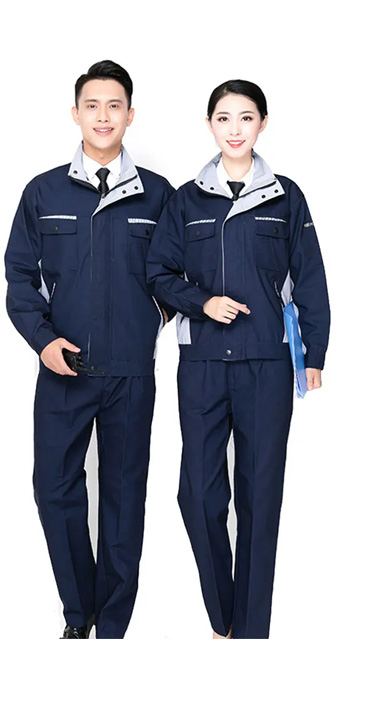
Worker fatigue is a documented contributor to workplace incidents. A study published in the Journal of Occupational and Environmental Hygiene found that discomfort from ill-fitting, heavy, or poorly ventilated workwear significantly increases the physiological strain on workers, leading to earlier onset of fatigue during physically demanding tasks. When a worker is fatigued, reaction time slows, grip strength decreases, and decision-making quality degrades—each of which elevates injury risk.
Safety workwear designed with ergonomic fit, breathable fabrics, and moisture management directly addresses these fatigue drivers. A well-designed safety uniform allows unrestricted movement, prevents heat accumulation during physical labor, and stays in place throughout the shift without requiring adjustment. Workers who are comfortable stay alert longer. Alert workers make fewer mistakes. Fewer mistakes mean fewer disruptions, fewer medical stops, and steadier production output.


Absenteeism costs industrial employers an estimated $3,600 per hourly worker per year in direct and indirect costs (SHRM, 2023). While not all of this is apparel-related, poorly specified labor safety uniform programs contribute in measurable ways. Workers who experience discomfort-related injuries—blisters from chafing seams, heat exhaustion from non-breathable fabrics, or cold stress from insufficient insulation—miss shifts that a properly equipped workforce would not.
Protective work clothes that match the thermal demands of the environment allow workers to perform through weather extremes without physiological strain that leads to sick leave. In cold storage facilities, inadequately insulated workwear leads to cold-related illness absences. In outdoor construction, insufficient UV protection leads to sunburn-related productivity loss. Matching occupational safety clothing to the actual working environment—not just the minimum regulatory requirement—reduces these preventable absences.
Color-coded safety uniforms serve an immediate communication function that reduces operational friction. When every worker on a site can instantly identify the electricians versus the riggers versus the supervisors, coordination improves and the handoff errors that slow projects decrease. Workers spend less time verifying roles and more time executing tasks. A study from the Construction Management Journal found that role-identifiable workwear reduced site coordination errors by 15% in multi-trade environments.
Beyond role clarity, consistent industrial uniform presentation projects organizational competence to clients, auditors, and visitors. A workforce that looks organized performs more cohesively. This is not cosmetic—visual consistency signals to workers themselves that they are part of a structured organization that takes its responsibilities seriously.
For businesses where workers interact directly with customers—utilities, telecommunications, field service, delivery—safety workwear with visible branding carries direct marketing value. A technician in a clean, well-fitted uniform bearing the company logo represents the brand in every interaction. Research from the Journal of Brand Management indicates that uniformed field service workers are perceived as significantly more trustworthy and competent than equivalent workers in unmarked clothing. This perception translates to customer satisfaction scores, contract renewals, and ultimately revenue.
OSHA and equivalent regulatory bodies specify minimum workplace safety apparel requirements. Non-compliance carries direct costs: fines, legal liability, and operational shutdowns. But the indirect costs are larger: a compliance failure that results in a serious injury damages reputation, increases insurance premiums, and creates turnover in the affected work group. A robust safety uniform program that exceeds minimum requirements is a form of risk management that reduces the probability of these cascading costs.
The most technically advanced safety uniform is worthless if workers remove it, cover it with personal clothing, or refuse to wear the assigned garment. Compliance with uniform policy is highest when the apparel is comfortable, fits properly, and workers have been involved in its selection. This means involving frontline workers in fit testing before committing to a production order. It means offering size ranges that actually fit your workforce. And it means selecting fabrics and constructions that perform in the real conditions your workers face—not the theoretical conditions described in a specification sheet.
Properly specified safety workwear reduces accidents by maintaining worker comfort and alertness, providing physical protection at hazard points, and enabling instant role identification in multi-trade environments. When workers are not distracted by discomfort or searching for colleagues by face rather than function, they focus on the task and reduce the error rate that causes incidents.
ROI calculations should include: reduction in apparel-related absenteeism (estimated $200–$600 per worker per year), reduction in uniform-related injury claims, improved customer satisfaction scores where workers interact with clients, and brand exposure value from branded workwear. Against these benefits, quality safety uniforms typically cost $40–$120 per garment—returning multiples of their value within the first year of use.
Replace safety workwear when fabric integrity is visibly compromised (thinning, tears, UV degradation), when reflective or hi-vis elements lose effectiveness, or when the garment no longer fits. In heavy-use industrial environments, most labor safety uniform programs replace core garments every 12–18 months.
Yes, positively when done well. Workers who feel their employer invests in their comfort and safety report higher job satisfaction. A safety uniform program that involves workers in fit testing, offers appropriate sizing, and selects garments that perform in actual working conditions is consistently associated with higher uniform compliance and improved worker retention.
Yes. Role-differentiated safety workwear programs use color coding, badge systems, and functional feature variations (hi-vis for road crews, chemical resistance for lab staff, flame resistance for welding) to create uniforms that serve both safety and operational identification purposes while maintaining brand consistency.
Safety uniforms are an investment in worker performance, not just protection. The evidence shows measurable impacts on fatigue, absenteeism, team coordination, and brand perception. For B2B buyers building or refreshing a safety workwear program, the decision framework should include comfort and ergonomics alongside regulatory compliance and cost. A uniform that workers actually wear, and wear correctly, delivers the productivity and safety outcomes the program was designed to achieve.
Society for Human Resource Management. (2023). Cost of Worker Absenteeism: Industry Benchmarks and Impact Analysis. SHRM Research.
Journal of Occupational and Environmental Hygiene. (2022). "Physiological strain from inadequate workwear in physically demanding occupations." Journal of Occupational and Environmental Hygiene, 19(6), 412–425.
Construction Management Journal. (2021). "Role-identifiable workwear and coordination efficiency in multi-trade construction environments." Construction Management and Economics, 39(11), 934–951.
Journal of Brand Management. (2023). "The effect of branded service worker uniforms on customer trust and perceived competence." Journal of Brand Management, 30(5), 678–693.
U.S. Department of Labor, Occupational Safety and Health Administration. Personal Protective Equipment Standards (29 CFR 1910). OSHA.
FOR NEWSLETTER
Subscribe to the weekly newsletter for all the latest updates