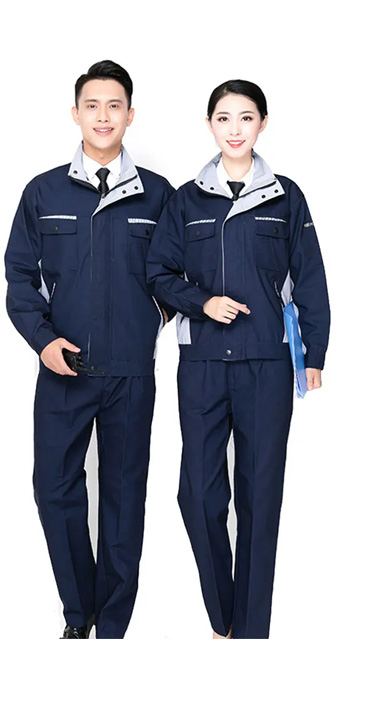
China remains the world's largest producer of work clothes, accounting for over 35% of global industrial workwear exports by volume (World Trade Organization, 2023). For procurement managers across manufacturing, construction, oil and gas, and logistics, sourcing from a Chinese work clothes manufacturer can deliver significant cost savings—but only if you select the right partner.
This guide distills years of hands-on sourcing experience into a practical framework for evaluating, negotiating with, and managing Chinese workwear factories.
China's competitive advantages go beyond labor costs. The country offers:
Complete supply chain integration – Fabric mills, dyeing facilities, accessories suppliers, and garment factories are often clustered within a single industrial zone.
Scale and flexibility – Factories can handle orders from 500 to 500,000 units without significant lead-time changes.
Technical expertise – Chinese manufacturers lead in flame-resistant (FR) fabric production, high-visibility garment construction, and functional finishing technologies.
However, quality varies dramatically between manufacturers. The key is knowing how to identify capable factories and avoid those that cut corners.
Before contacting any workwear supplier, prepare a detailed specification sheet:
Fabric composition and weight (e.g., 65/35 polyester/cotton, 210 gsm)
Design and construction – Stitch type (overlock, flatlock, chain stitch), seam placement, pocket configuration
Safety certifications required – EN ISO 11612, ANSI/ISEA 107, NFPA 70E, etc.
Order volume and frequency – Annual estimated quantity and reorder schedule
Target unit price – Including packaging and shipping to your destination port
Lead time expectations – From PO confirmation to warehouse delivery
A well-prepared spec sheet filters out factories that cannot meet your standards, saving weeks of back-and-forth communication.
Do not rely solely on a supplier's website claims. Conduct independent verification across three dimensions:


Request a third-party audit report from SGS, Intertek, Bureau Veritas, or TÜV Rheinland. Key areas to examine include:
Production capacity versus claimed output
Quality management system (ISO 9001 certification)
Social compliance (BSCI, SA8000, WRAP)
In-house testing laboratory capabilities
Ask for test reports from accredited laboratories covering your required safety standards. Cross-check certificate numbers with the issuing body. A common red flag: certificates that cover the fabric but not the finished garment.
Request at least three client references in your region or industry. A reputable work clothes manufacturer will readily provide contacts. Follow up—ask about order accuracy, lead-time consistency, and how the factory handles defects.
MOQs in China range from 500 to 5,000 pieces per style. Negotiate lower MOQs for trial orders—many factories accept 200–300 pieces for first production runs if you demonstrate volume potential.
Professional factories deliver samples within 7–10 business days. If a supplier takes more than three weeks, it indicates either disorganization or outsourcing to smaller workshops.
Evaluate responsiveness, English proficiency, and technical understanding. A factory that asks clarifying questions about your specifications is generally more reliable than one that simply says "no problem" to everything.
Implement a multi-stage QC process:
Pre-production inspection (PPI) – Verify raw materials, fabric color swatches, and accessory quality before bulk cutting begins.
During-production inspection (DPI) – Check at 20–30% completion for sewing quality, sizing accuracy, and certification label placement.
Final random inspection (FRI) – Use AQL 2.5/4.0 standards (ISO 2859-1) for the final shipment check.
Hiring an independent QC company based in China for inspections costs approximately $200–$350 per visit—a fraction of the cost of accepting a defective shipment.
Substitution of materials – Specified 280 gsm fabric replaced with 220 gsm. Mitigate with pre-production fabric testing.
Intellectual property theft – Your custom design appearing in a competitor's catalog. Use NDA agreements and register designs in China before sharing specifications.
Hidden costs – Import duties, port fees, and inland transport can add 15–25% to the FOB price. Request delivered (DDP) pricing for accurate total cost.
Seasonal capacity constraints – Chinese factories experience peak seasons (July–October) when lead times extend by 30–50%. Plan orders accordingly.
Standard payment terms for new suppliers are 30% deposit + 70% before shipment. For established relationships, negotiate 30/70 with a letter of credit or Net 30 after inspection. Never pay 100% upfront—this eliminates your leverage if quality issues arise.
Standard lead time is 30–45 days from sample approval to shipment, depending on order volume and factory workload. Add 15–30 days for ocean freight depending on your destination port.
Savings typically range from 30% to 60% compared to U.S. or European manufacturing, depending on fabric complexity and certification requirements. FR-certified garments carry a smaller margin differential due to specialized material costs.
Yes. Many leading Chinese factories produce garments certified to EN ISO 11612, NFPA 2112, ANSI/ISEA 107, and AS/NZS standards. The critical step is verifying that the finished garment—not just the fabric—holds certification.
The Canton Fair (Guangzhou, April and October), CPM (Children & Maternity, but adjacent to workwear sourcing), and A+A (Düsseldorf, though international) are key events. Alibaba Trade Assurance and Made-in-China.com also facilitate virtual factory tours.
Include detailed defect clauses in your contract specifying replacement, credit, or refund terms for each defect category. Maintain photographic evidence and request factory acknowledgment before disposing of defective goods.
Selecting a reliable work clothes manufacturer in China requires rigorous due diligence, clear specifications, and ongoing quality management. The potential savings are substantial, but they are only realized when you invest the time to verify capabilities before committing to large orders. By following the audit, certification, and QC framework outlined here, procurement professionals can build long-term supplier relationships that deliver consistent quality, competitive pricing, and reliable supply chain performance.
World Trade Organization. (2023). World Trade Statistical Review 2023: Textiles and Apparel Trade Flows. WTO Publications.
International Organization for Standardization. (2018). ISO 9001:2015 – Quality Management Systems.
ISO 2859-1. (1999). Sampling Procedures for Inspection by Attributes.
Z. Wang et al. (2022). "Quality management practices in Chinese garment manufacturing: A supply chain perspective," Journal of Manufacturing Technology Management, 33(4), 789–812.
L. Chen & M. Wang. (2021). "Third-party inspection effectiveness in cross-border apparel sourcing," Supply Chain Management: An International Journal, 26(6), 1452–1470.
FOR NEWSLETTER
Subscribe to the weekly newsletter for all the latest updates