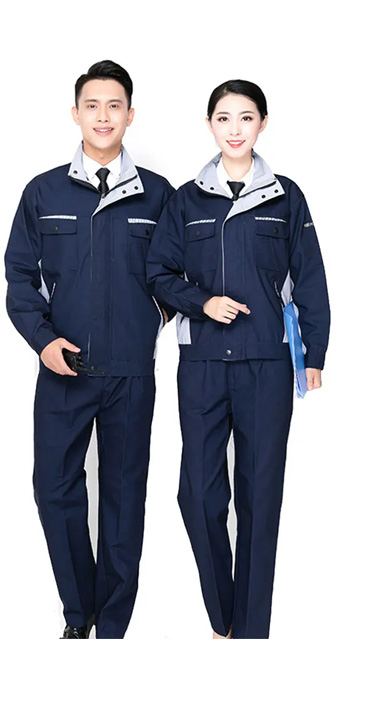
Custom work pants are a cornerstone of industrial uniform programs, construction safety wear, and skilled-trade professional apparel. Unlike casual trousers, custom work pants must withstand abrasion, chemical exposure, repeated industrial laundering, and the physical demands of active occupations—while remaining comfortable enough for full-shift wear. The global industrial workwear market, valued at over $92 billion in 2024 (MarketsandMarkets, 2025), reflects the scale of demand for durable, professionally branded workwear. This article provides a procurement-focused breakdown of work pants materials and the custom work pants production process.

Cotton duck canvas is the traditional choice for heavy-duty work pants. The tight, durable weave provides exceptional abrasion resistance—critical for carpentry, masonry, and metal fabrication environments. Fabric weights range from 280 gsm (lightweight) to 400 gsm (extra heavy), with 320–360 gsm being the standard for general industrial use. The tight weave also resists wind and light water penetration.
Cotton duck accepts wax and DWR (durable water repellent) finishes that enhance water resistance without compromising breathability. However, 100% cotton duck is susceptible to shrinkage (≤5% Sanforized) and requires care to prevent stiffening after repeated laundering.
Cotton-polyester blend work pants (typically 65/35 or 60/40) combine the comfort and breathability of cotton with the strength, wrinkle resistance, and colorfastness of polyester. Twill weave—the same construction used in chinos and casual trousers—provides a professional appearance suitable for corporate work pants programs while maintaining durability.
Advantages: 50% lower shrinkage than cotton duck, faster drying, better shape retention.
Disadvantages: Slightly lower abrasion resistance, reduced breathability in hot conditions.
Best for: Warehousing, logistics, facilities management, indoor industrial environments.
Ripstop work pants use a reinforced grid pattern—typically 400–500 denier nylon or polyester—with interlocking threads that prevent small tears from spreading. Ripstop fabrics are lightweight, water-resistant, and highly tear-resistant relative to their weight. These pants are increasingly specified for outdoor trade professionals, landscaping, and pest control where freedom of movement and weather resistance are priorities.
Stretch work pants incorporating 5–15% spandex (Elastane) or Lycra in cotton-polyester blends address the growing demand for mobility-optimized workwear. Originally adopted in athletic and outdoor markets, stretch work pants are now specified for HVAC technicians, electricians, and mechanics who require unrestricted movement in confined spaces. 4-way stretch fabric panels at the knees and inseam significantly improve range of motion without sacrificing durability.
Beyond fabric, the functional features of custom work pants differentiate professional-grade garments from basic work trousers:
Cargo pockets – Deep, multi-compartment pockets for tools and personal items. Reinforced bottoms prevent sagging under tool weight.
Knee pad pockets – Internal compartments for foam or gel knee pads (EN 14404 compliant), essential for flooring, tiling, and masonry work.
Hammer loops and tool rings – Reinforced nylon loops positioned for dominant-hand accessibility.
Reinforced knees and seat – Double-layer fabric panels in high-wear zones extend garment life by 40–60%.
YKK or equivalent zippers – Quality zippers at fly and pockets prevent failures that compromise usability.
Gusseted crotches – Diamond-shaped gusset eliminates seam stress and allows wider range of motion.
The custom work pants production process begins with a detailed specification sheet covering fabric type, weight, color (Pantone references), construction details, functional features, safety certifications, and size range. The factory develops paper patterns and grade rules—the scaling system that increments the pattern across sizes—for the required size range (typically 28–48 waist, multiple inseams).
The factory produces proto samples (first-off samples) for fit and design evaluation. B2B buyers should conduct rigorous fit testing across all sizes—purchasing or borrowing garments in each size to evaluate body fit, pocket access, and comfort on the intended end user. Adjustments are incorporated into the fit sample for final approval before bulk cutting begins.
Once the fit sample is approved, fabric is spread in multiple layers on a cutting table and cut using either manual die-cutting (for simpler shapes) or automated computerized cutting (CAM) for precision and consistency. Marker efficiency—the percentage of fabric utilized—directly affects material cost. Experienced manufacturers achieve 85–92% marker efficiency.
Industrial sewing operations assemble cut panels into finished garments. Critical quality checkpoints include:
Stitch density – Minimum 8 SPI (stitches per inch) on main seams; 10–12 SPI on reinforced areas.
Thread tension consistency – Uneven tension creates puckered seams.
Bar tacking – Reinforced stitching at pocket corners, fly, and stress points prevents seam failure.
Waistband construction – Stiffener insertion and taping ensure shape retention through heavy-use cycles.
Finished custom work pants undergo visual inspection, dimensional measurement (against tolerance specs), seam strength testing (ISO 13935-2), and color consistency checks against approved lab dips. Decoration—screen printing, embroidery, or heat transfer—is applied after QC inspection to avoid costly re-work if defective garments are found.
Full custom work pants production (cut-and-sew) typically requires 500–1,000 pieces per style per color. Some manufacturers accept 300-piece MOQs for basic styles with simple construction. Blank-stock decoration on pre-made work pants can start at 24–48 pieces.
For hot climates, specify a cotton-polyester twill (65/35) at 200–240 gsm—lightweight enough for airflow while maintaining durability. Ripstop nylon work pants offer superior ventilation. Avoid heavy canvas (360+ gsm) in environments above 30°C, as heat stress risk increases significantly with heavier fabrics.
Request knee pad pockets compatible with EN 14404 Type 2 knee pads. Specify pocket dimensions that accommodate the specific pad model you intend to stock. For multi-season use, consider removable pad designs that allow seasonal pad removal in warmer months.
Depends on application: EN ISO 11612 for flame exposure, EN 13034 for chemical splash, ANSI/ISEA 107 for high visibility, and EN 14404 for knee protection. Request third-party test reports from accredited laboratories (SGS, Intertek, UL) covering the finished garment.
Standardize work pants specifications across roles to consolidate order volumes. Reduce color variety (each color requires a separate fabric dye lot and QC batch). Specify 65/35 cotton-polyester blends instead of 100% cotton to reduce shrinkage claims and extend garment life.
Understanding custom work pants materials and the production process empowers B2B procurement professionals to write precise specifications, evaluate supplier capabilities accurately, and make sourcing decisions that optimize both upfront cost and total garment lifecycle value. By focusing on fabric selection aligned to end-use conditions, functional feature requirements, and rigorous quality control checkpoints, organizations can build workwear programs that protect workers, project professional brand image, and deliver reliable long-term cost performance.
MarketsandMarkets. (2025). Industrial Workwear Market Size, Share & Trends Analysis Report, 2024–2029.
International Organization for Standardization. (2014). ISO 13935-2:2014 – Seam Strength of Fabrics. ISO.
European Committee for Standardization. (2019). EN 14404:2010+A1:2013 – Knee Protectors for Knee Protection at Work. CEN.
Y. Liu & R. Hall. (2023). "Abrasion resistance mechanisms in woven workwear fabrics: A comparative study," Journal of Engineered Fibers and Fabrics, 18, 1–13.
D. Thompson. (2022). "Comfort and mobility in industrial workwear: Evaluating stretch fabric performance," Applied Ergonomics, 101, 103707.
FOR NEWSLETTER
Subscribe to the weekly newsletter for all the latest updates