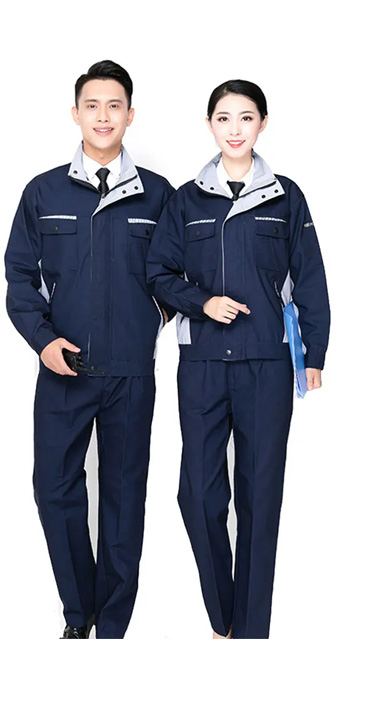
No safety feature matters if the garment fails before the shift ends. High-quality work clothes must maintain their integrity through the physical demands of the job, repeated industrial laundering, and the accumulated abuse of daily use. Durability is not a single property—it is the product of several coordinated choices in fabric, construction, and hardware.
The most direct durability indicator is fabric weight. For labor protection work clothes, the appropriate weight depends on the environment: a logistics warehouse worker needs different protection than a steelworker or a road crew. Common ranges include 180–220 gsm twill for indoor light-duty workwear, 280–360 gsm duck canvas for construction and heavy labor, and 400+ gsm for extreme-duty applications. A fabric that is too light will fail prematurely; one that is too heavy restricts movement and increases cost without adding proportional protection.


High-stress points—knees, elbows, seat, and pocket corners—require reinforcement. Durable work clothes use double-layer fabric panels, Bartack stitching at stress points, and Cordura or other high-tenacity nylon overlays in the most-abraded areas. The cost of reinforcement is modest; the extension in garment service life is substantial. We regularly see reinforced workwear lasting 18–24 months in heavy industrial use, compared to 6–9 months for unreinforced alternatives.
Zippers, snaps, and buckles are frequent failure points. Work clothes supplier specifications should require branded hardware—YKK, SBS, or equivalent—in closures. A zipper that fails mid-shift creates a safety and dignity issue. Budget hardware is a false economy.
For workers near traffic, moving equipment, or low-light environments, high-visibility workwear is a life-safety requirement. Effective high-visibility labor protection work clothes combine fluorescent background material (typically EN ISO 20471 Class 2 or 3 compliant) with retroreflective tape strips at the torso, arms, and legs. The tape must be retroreflective—ordinary reflective materials lose effectiveness under diffuse lighting. Apparel meeting ANSI/ISEA 107 or EN ISO 20471 standards has been tested for minimum brightness and durability through washing.
Flame-resistant work clothes are essential for workers exposed to sparks, open flames, molten metal, or electrical arcs. FR protection is achieved either through inherent FR fibers (aramid, modacrylic, FR rayon) or through chemical treatment of conventional fibers. Inherent FR fibers maintain their protection for the life of the garment; treated fabrics lose effectiveness over time with laundering and wear. The relevant standards include NFPA 2112 (U.S.), EN ISO 11612 (Europe), and IEC 61482 (arc flash). A work clothes manufacturer should provide third-party test certificates for the FR claims they make.
Practical pocket design is often overlooked in industrial workwear but significantly affects worker efficiency. Cargo pockets with secure closures keep tools accessible without requiring workers to leave the work area. Pen pockets, ID holders, and phone pockets are increasingly expected in modern work clothes. Reinforced bottom pockets prevent sagging under tool weight—without this detail, cargo pockets become decorative rather than functional.
A garment that workers find uncomfortable will be worn incorrectly—unbuttoned, removed during breaks, or replaced with personal clothing that provides no protection. Comfort is therefore a safety variable, not a soft consideration.
Workers in physically demanding roles generate significant heat and perspiration. Fabrics that manage moisture—wicking it away from the skin and releasing it to the air—reduce the chilling effect when workers step from exertion into cold air and prevent the accumulation of dampness that degrades comfort and can accelerate hypothermia in cold environments. Cotton-rich blends, mesh ventilation panels, and moisture-wicking synthetic fabrics each address this need differently. The choice depends on the ambient temperature range and the intensity of physical activity.
High-quality work clothes are cut for mobility. A garment that is too tight restricts movement and creates safety hazards; one that is too loose catches on equipment. Articulated knees, gusseted crotches, and raglan or set-in sleeves with adequate reach distance address the specific movements different jobs require. A fit that allows a full squat without exposing the lower back is a practical minimum standard for labor protection garments.
Heavy workwear causes fatigue. The additional energy required to move additional fabric weight accumulates over an eight-hour shift. Modern durable work clothes use lighter-weight fabrics with reinforced weave structures to achieve equivalent durability at lower weights. Buyers should specify the weight appropriate to the job rather than defaulting to the heaviest available option.
Work clothes serve as a visual identifier of role, employer, and safety status. Consistent, professional appearance projects organizational competence to customers and visitors. For businesses operating in hospitality, retail, or service environments where employees are customer-facing, the aesthetic dimension of labor protection work clothes is as important as the functional dimension. A garment that employees are proud to wear produces higher compliance than one they regard as a penalty.
Workwear that cannot survive industrial laundering degrades rapidly in institutional laundry environments. High-quality work clothes must be specified to withstand the temperatures, detergent chemistry, and mechanical agitation of commercial and industrial laundry—typically 60–85°C wash cycles with alkaline detergents. Fabric colorfastness to industrial laundering should be verified per AATCC or ISO test methods. A garment that bleeds color, shrinks beyond tolerance, or falls apart after 20 industrial wash cycles is not a cost-effective choice regardless of its initial price.
Specify fabric pre-shrunk and sanforized to maximum 3% residual shrinkage. Request colorfastness testing to AATCC 61 (laundering) and AATCC 135 (dimensional stability). Choose higher thread counts and tighter weaves for color retention. A work clothes supplier who knows industrial laundry will already build these requirements into their standard production specs.
Centralized annual procurement typically achieves 30–50% cost reduction compared to ad-hoc purchasing. Standardize specifications across roles where possible to consolidate order volumes. Choose a small number of core styles and colors rather than managing a wide range—this simplifies inventory, reduces unit cost, and makes replacement easier. A work clothes supplier relationship built on volume commitment unlocks better pricing and priority production slots.
In the U.S., ANSI/ISEA 107 is the governing standard for high-visibility safety apparel. In Europe, EN ISO 20471 applies. Both cover similar performance criteria—minimum quantities of fluorescent background material and retroreflective tape at specific body locations—but the classification system and test methods differ. If you source globally, confirm your work clothes manufacturer holds certification for both standards.
Yes. The assumption that protective workwear must be heavy and uncomfortable is outdated. Modern fabric engineering—moisture-wicking treatments, articulated cuts, lightweight FR fibers, and mesh ventilation panels—produces high-quality work clothes that meet safety standards while allowing the range of motion and temperature regulation workers need to stay productive.
Replacement intervals depend on the garment type, use intensity, and care conditions. A general guide: hi-vis outerwear replaced when retroreflective tape effectiveness degrades or fabric integrity is compromised; industrial work pants replaced when fabric thinning or seam failure appears; FR garments replaced per the manufacturer's stated cycle life and after any incident involving significant heat or flame exposure. Replace any work clothes showing visible damage, excessive fading, or compromised safety features immediately.
Evaluating labor protection work clothes requires looking beyond appearance to the combination of durability, safety performance, comfort, and washability that determines whether a garment protects workers throughout its service life. The most expensive workwear is the kind that sits in a locker because workers find it uncomfortable or impractical. The best workwear is specified with the worker's actual tasks in mind—breathable for hot environments, heavy-duty for abrasion exposure, FR-rated where heat and flame are present, hi-vis where visibility is critical. A B2B buyer who understands these features can work with a capable work clothes supplier to build a labor protection program that workers actually use, which is the only outcome that counts.
U.S. Department of Labor. Occupational Safety and Health Administration (OSHA) Personal Protective Equipment Standards – 29 CFR 1910. OSHA.
ASTM International. ASTM F1506: Standard Performance Specification for Flame Resistant Textile Materials for Wearing Apparel.
International Organization for Standardization. EN ISO 20471:2017 – High Visibility Warning Clothing.
NACE International. Material Selection and Care Guidelines for Industrial Workwear Fabrics in Corrosive Environments.
P. Kumar & R. Singh. (2022). "Ergonomic fit and worker compliance in industrial workwear programs." Applied Ergonomics, 101, 103689.
FOR NEWSLETTER
Subscribe to the weekly newsletter for all the latest updates